Where does one begin when speaking of the city that began
before any other European settlement in the United States? St. Augustine can’t
be summed up in a blog post, and despite its relatively small size it’s still
tough to see all of its landmarks in two days. Nevertheless, I tried.
The St. Augustine Cathedral Basilica is in the northwest corner of the city’s main plaza and the first parish established in the United States.
Spanish missionaries began missions in Florida 100 years before those in the West. St. Augustine
Cathedral could be considered the archetype of Spanish Mission architecture,
with its adobe walls, surrounding plazas and smooth arching shapes. It’s remarkable to see an architectural style common in the West
within an East Coast city.
Unlike many basilicas that are awe-inspiring with their celestial domes and elaborate grounds, the authenticity of St. Augustine Basilica is in its intimacy. As soon as you enter, the low ceilings remind you that you're in a church that was built in an outpost of the Spanish Empire, not some booming capital city. The dim lighting makes you feel like you've been transported to a time when the only interior light came from windows, candles and oil lamps.
Just down the road from the basilica is Flagler College, with spires rising up more distinctly
than any other building in the city. The great entrepreneur and philanthropist, Henry Flagler, built the structure, which was originally the Ponce de Leon Hotel. Flagler, the founder of Standard Oil and the Florida railroad made many other large contributions to the city, but when it came to sharing his business success in the city, he wasn't as generous. Rumor has it that Frank Smith, a Boston millionaire, had ambitions to build a hotel right by Flagler's, but Smith couldn't get all the materials he needed down to St. Augustine without using Flagler's railroad, and Flagler would have none of that. He closed the railway to the train bringing down Smith's furnishings for the hotel. Naturally Smith's establishment didn't succeed.
Flagler College, formerly the Ponce de Leon Hotel
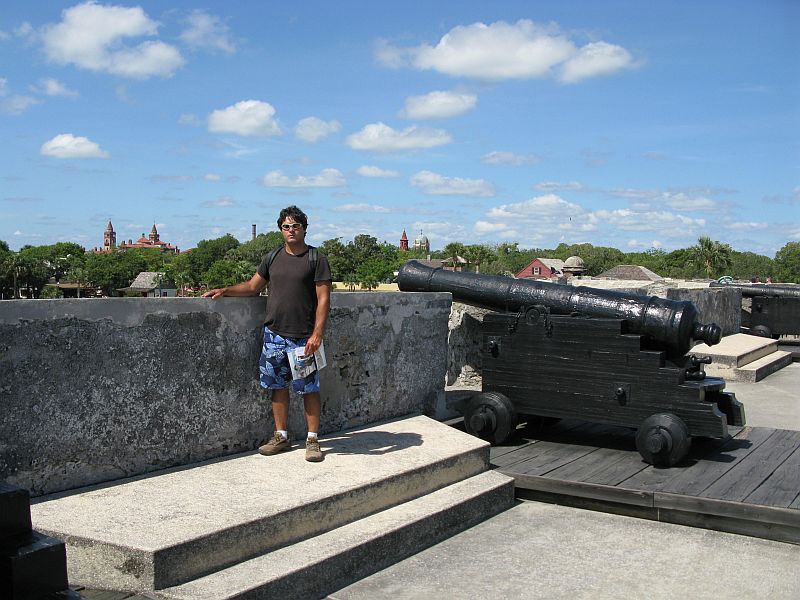
Castillo de San Marcos volunteers fired a canon for visitors
on Memorial Day.
Captain Ken video
The fort was built by the Spanish in 1696 as a stronghold to guard their ships, which traveled up the Florida coast from the Caribbean and used the Gulf Stream to get back to Spain. The strategic location of St. Augustine was coveted by the French and English, but Castillo de Marcos successfully defended every attack from these enemies, even after the city burned down in 1702. But as long as the fort stood the Spanish were able to maintain control of the settlement.
Captain Ken photo
St. George Street is a pedestrian only street lined with stores and restaurants, and it was packed with tourists passing through the historic city or locals enjoying a day trip on Memorial Day.
As I continued to intentionally wander and take in as much of the city as possible, a majestic dome peered out above the palm trees in the corner of my eye. It was the dome of the Flagler Memorial Presbyterian Church. Built by Henry
Flagner in memory of his daughter who died tragically, the church is the only
Presbyterian church I’ve seen built in the Venetian Renaissance revival
architecture style. As I passed and took pictures, I heard someone say that this was the city's basilica, basing their comment on the fact that they heard the city had a basilica. Err, wrong. The basilica is right in the middle of the city, just north of the main plaza. They wouldn't tuck a basilica behind the campus library, for goodness sake!
Although, I was a bit jealous in noticing that the Presbyterians might just have a more beautiful church than Catholics in one of the most historically Catholic cities in the U.S. But they had a millionaire philanthropist build theirs, so that's not fair. No hard feelings though. I celebrate all beautiful churches simply because they glorify God. Going back to our ignorant tourists, as they passed by the church they said nothing more about it except "It's very old".
One of my favorite sites in my St. Augustine wanderings was a locale that wouldn't be worth much at all to anyone else, but I must include it anyway in my snapshot of the city. As I was looking for a place to buy milk, I wandered off the beaten path a little and found myself strolling down this side street that most accurately depicts the humble Americana culture of the south.
This street was maybe two blocks from the city's renowned historic section. Here's to intentionally wandering and coming across things you didn't expect.